Pregnancy Wellness Program Vs Prenatal Yoga: The Difference
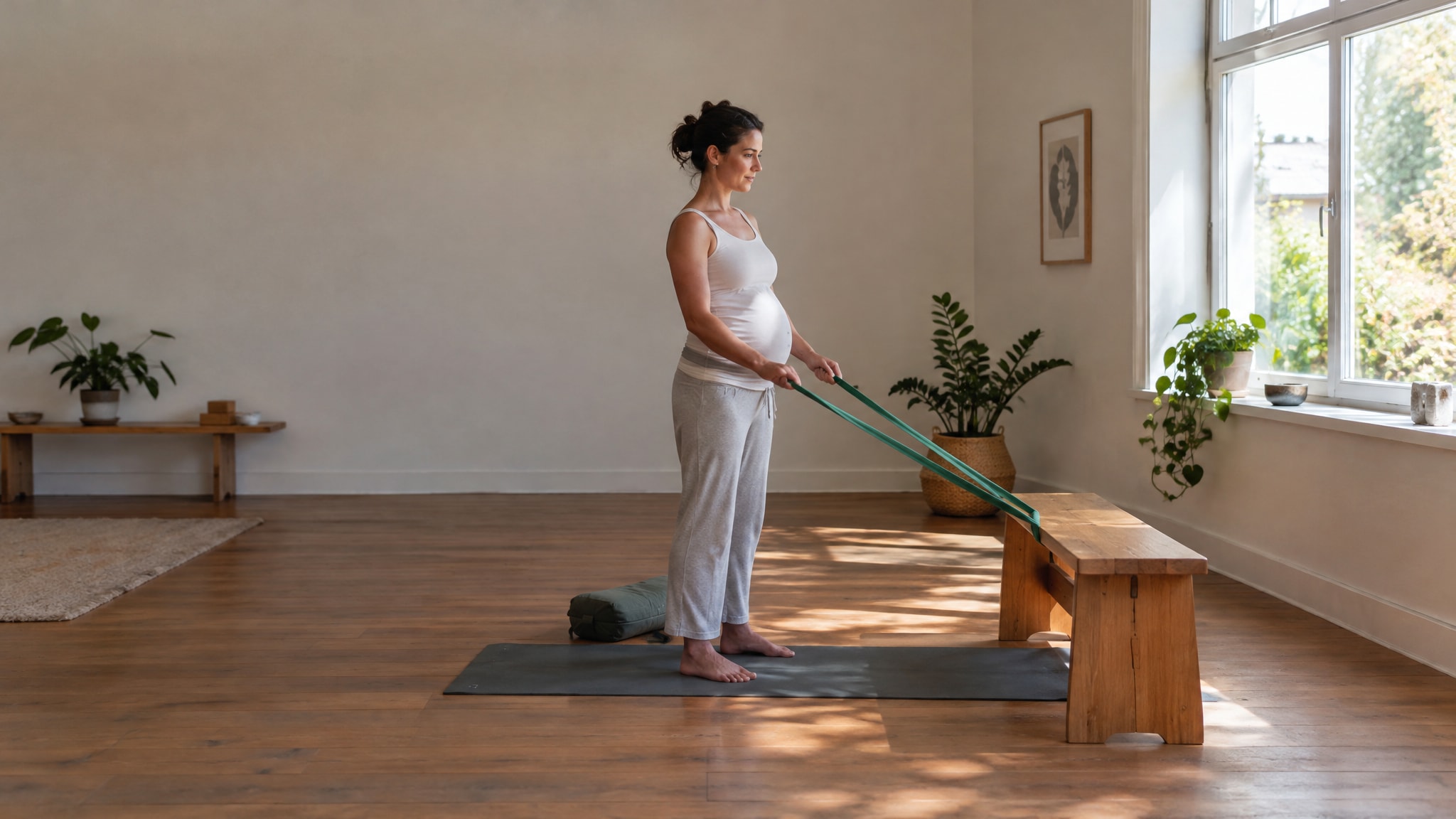
Women often ask me some version of the same thing. They're pregnant, or hoping to be, and they've found a prenatal yoga class near home. Then they've heard about one-on-one support and can't tell how the two differ.
I'm Loukas Panether. I came to this work from personal training, and my practice is rooted in my own family's history with pregnancy loss and trauma. I run a pregnancy wellness program, so I'm obviously not neutral. But I've spent years watching what helps women and what leaves them feeling unseen, and I'd rather give you a fair comparison than a sales pitch. Some of you will be better off in a class, and I'll say so.
Prenatal yoga and the pregnancy wellness program, defined
A prenatal yoga class is a group session led by one instructor, designed for pregnant women. Most follow a familiar shape: a gentle opening, breathing practice, a sequence of modified poses, and a long rest at the end. You roll out a mat beside other women at different stages, and the instructor sets the pace for everyone.
A pregnancy wellness program is a different kind of thing. It's a structured, personal plan that combines prenatal physical training with emotional support and birth preparation, built around one woman rather than a room. I work with women from the months before conception right through to birth. In person, that means my 18-month package in St Kidla East. Women elsewhere use the online Pregnancy Wellness Program.
Two small points on language, because they trip people up. "Prenatal" and "antenatal" generally mean the same thing: antenatal is the term you'll hear more often in Australian hospitals and clinics, prenatal in fitness and wellness. And "coaching" and "program" describe the same service in this article, a structured, personal relationship rather than a drop-in class.
Individual versus group pregnancy classes: where attention differs
The real difference between these options isn't the exercise. It's who the plan is built around, and how often it changes.
A class runs one routine for the whole room. A one-on-one plan is adjusted around your symptoms, your energy and your diary, week by week. That gap is the one most comparison pages leave unmentioned, and it's the one that matters most for the women I see.
What one-on-one pregnancy support changes in a session
Pregnancy doesn't move in a straight line. One week you feel strong, and the next you're exhausted, nauseous, or lying awake worrying about a scan. A plan written in week eight rarely suits you in week twenty-two.
Take a typical case. A senior manager goes to her group class after a long week. The instructor moves the room into a pose that doesn't feel right for her hips, so she quietly adapts it herself and says nothing, because twelve other women are mid-sequence. In a one-on-one session, she'd mention it in the first five minutes, and we'd change the plan that week.
That's what one-on-one pregnancy support offers: someone who notices, asks, and adjusts. It matters even more after a past loss. A woman carrying that history may find a perfectly good session suddenly hard, because a particular week, a particular gestation or a particular appointment lands heavily. A group instructor can't reshape a class around that, and nobody should expect them to.
What a shared class gives you that one-on-one support does not
A class gives you other pregnant women, and that's no small thing. Sitting in a room of women who understand the tiredness, the odd aches and the looming birth can ease a loneliness that many of my clients feel, even those with plenty of friends.
A class also gives you a set routine. Some women find real comfort in turning up at the same time each week and having someone else decide what happens. There's nothing to plan, nothing to negotiate, and no pressure to explain how you're feeling.
One-on-one support doesn't give you that room full of women, and I won't pretend it does. If community is what you're missing most, a class does it better than I can.
Physical training and emotional support in one plan
Here's where the options start to look quite different in what they actually cover, and where the program makes its own distinct claim. If you want movement and nothing else, a good class may be all you need.
Prenatal yoga versus personal training
Yoga is strong on breath, mobility and relaxation. Those are useful skills for pregnancy and birth, and a calm hour once a week does many women good. Personal training is strong where yoga is usually not: progressive strength work, built up carefully so that your legs, back and core can carry the changes of pregnancy and the physical demands of early motherhood.
Pilates sits somewhere between them, and women often ask me which is better. I don't think the label decides it. A Pilates class of fifteen with one instructor has the same limits as a yoga class of fifteen, and a small, attentive session of either can serve you well. What counts is whether the work is structured, whether it progresses, and whether the person teaching it knows how you're going this week.
The program combines both sides: adapted physical training that builds strength, with the breath and mobility work that yoga does well, all shaped around you.
Why the emotional side belongs in the plan
Most of the women I work with are highly capable. They run teams, argue cases, manage budgets. Pregnancy is one of the few things they can't plan their way through, and that can be frightening. Add a past loss, a difficult birth story or a family history like mine, and the fear sits right alongside the physical changes.
So I don't separate the two. When we train, we talk. If a woman arrives anxious, the session shifts, and sometimes the conversation is the most useful part of it. Most group classes aren't set up to offer that in any depth, and they aren't meant to be. If you're navigating loss, you can read more about support for women after miscarriage.
This isn't therapy, and it doesn't replace your midwife, your doctor or a psychologist when you need one. It's steady, personal support that runs alongside them.
Pregnancy fitness options compared: who each one suits
I'd rather describe the women each option tends to suit than hand you rules. You'll know which profile sounds like you.
When a group prenatal yoga class is the better fit
A class suits a woman whose pregnancy is straightforward and who wants company, a set routine and a gentle, regular hour for herself. She's comfortable adapting a pose when something feels off, and she doesn't need her plan rewritten each week. She may also want a lower-cost, lower-commitment way to start moving.
If that sounds like you, book a class and enjoy it. You don't need one-on-one support to have a good pregnancy, and I'd never suggest otherwise.
When structured one-on-one support is the better fit
One-on-one support tends to suit a woman who is trying to conceive and wants to prepare her body and mind first. If that's you, have a look at preconception coaching in Melbourne. It also suits a woman managing fear or a past loss, and one who is fitting training around a demanding career, where the only free hour moves around.
Many of the professionals I meet want what they'd expect in the rest of their lives: a plan, a person accountable to it, and someone who adjusts as things change. I've written about why high-performing women hire a birth preparation coach, if you'd like that reasoning in full.
What each option asks of your time, money and travel
A class usually costs less per session and runs on a fixed timetable. You go to the studio, at the hour on offer, and your week has to bend around it. If you work long or unpredictable hours, that fixed slot can become one more thing you miss.
One-on-one support is a larger commitment, in both time and money, but a more flexible one. Sessions can fit around your schedule, and the plan adapts when work, nausea or a hospital appointment gets in the way. My in-person package in St Kilda East runs for 18 months, so it covers the stretch from before conception through to birth. You can see what the 18-month program costs in detail, because I won't try to squeeze it into a sentence here.
Travel is the other cost. If you're not near St Kilda East, the online Pregnancy Wellness Program works from anywhere, and how the online program works is set out on its own page. You don't have to live in Melbourne to have personal support.
What the evidence does and does not tell you
The research on prenatal yoga is larger than on almost any other form of pregnancy exercise, and it's generally positive for stress, sleep and back discomfort. Many of those trials are small, so I'd call the findings encouraging rather than settled. That's a fair reason to take a class seriously.
Research on one-on-one pregnancy coaching as a category is thinner. I can't point you to a body of trials and say the evidence favours my work over a class. The case for the program rests on tailoring and relationship: a plan that changes with you, and a person who knows your history.
Most antenatal guidance treats gentle, low-impact movement as suitable for uncomplicated pregnancies, with individual advice from the treating midwife, GP or obstetrician. That applies to both options. Whichever you choose, check with the person looking after your pregnancy first, especially if you've had complications or a previous loss.
Can you do both, and where to start
Yes, and some women do. They keep a weekly class for the company of other pregnant women and use one-on-one support for the strength work, the planning and the harder conversations. If you go that way, tell your coach about the class so we can agree on timing. Two demanding sessions on the same day wouldn't help you.
If you're still unsure, start with the question that matters most to you. Do you want company, or do you want attention? A class answers the first well. One-on-one support answers the second.
I'm always glad to talk it through, and there's no pressure to commit to anything. Get in touch and tell me where you are, whether that's planning, trying or already pregnant, and we'll work out which option fits. If you want structured, personal support, the Pregnancy Wellness Program is where I'd point you.
Frequently asked questions
What is a prenatal program?
A prenatal program is a structured plan of support across pregnancy, rather than a single class. The Pregnancy Wellness Program combines adapted physical training, emotional support and birth preparation, and is built around one woman. It can begin in the months before conception and run through to birth.
Is pregnancy Pilates or yoga better?
Neither wins on the label alone. Yoga is strong on breath, mobility and relaxation, and Pilates can be a good option too. What matters is whether the sessions are structured, progress over time and are adjusted to how you're feeling that week.
Is prenatal the same as antenatal?
Generally, yes. Antenatal is the term you'll hear more in Australian clinics and hospitals, and prenatal is more common in fitness and wellness. Either way, check any exercise plan with your midwife, GP or obstetrician before you start.
Can I do the Pregnancy Wellness Program if I don't live in Melbourne?
Yes. The online Pregnancy Wellness Program is available to women anywhere, while the 18-month in-person package runs in St Kilda East. You get the same personal approach either way.
Can I keep my prenatal yoga class and have one-on-one support too?
Many women do. A class gives you community and a set routine, and one-on-one support gives you tailored training and emotional support. Tell your coach about the class so the timing of both can be agreed.